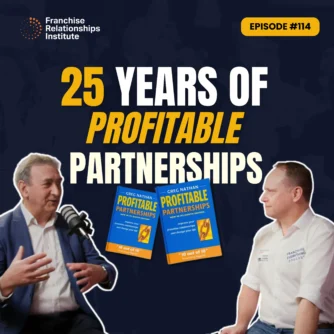
It Goes Without Saying That Greg Nathan, On A Global Scale, Has Arguably Had The Most Significant Impact on the Relationship and Therefore, Success, Between Franchisees and Franchisors Than Any Other.
Episode Timeline
- 0:00 – Introduction of the podcast and live stream from the Melbourne Expo
- 0:33 – The Franchise E-Factor: interdependent relationships in franchising & life
- 1:47 – Origin of the E-Factor in 1992, part of *Profitable Partnerships*
- 2:22 – How the E-Factor is used with franchise brands & franchisees
- 2:48 – Applications outside franchising: any interdependent relationship
- 3:52 – Customer relationships vs interdependent relationships
- 4:30 – Is the customer always right?
- 5:19 – Stages of the E-Factor: starting with the Glee stage
- 6:24 – Fee Stage: questioning the value of fees
- 7:13 – Me Stage: attributing successes to self, frustrations to franchisor
- 8:38 – Coaching field teams to approach the ‘Me’ stage
- 9:28 – Free Stage: desire for independence, rebellion or disengagement
- 11:01 – See Stage: understanding the broader picture through respect
- 11:54 – We Stage: collaboration, trust & cooperation
- 12:56 – Breakthrough or exit: the Free stage turning point
- 14:14 – Role of lawyers in franchise conflicts & quick settlements
- 14:34 – The satisfaction of impacting the marketplace
- 15:08 – Where to get copies of *The Franchise E-Factor*
- 15:24 – Closing remarks on *The Franchise E-Factor*
In this EXPLAINER, we asked Greg to talk us through in detail the stages of his famous Franchise E-Factor model that is the framework for the franchisee – franchisor relationship.
With well over 300,000 combined copies sold of Greg’s publications on franchising he is the thought-leader on strategies and approaches to getting the most out of the franchisee franchisor relationship.
The Franchise E-Factor Model was initially a single chapter in the best-selling book, Profitable Partnerships. However, seeing the impact that the model was having, it was clear that delving deeper into the model and strategies around it was called for.
The ‘E-Factor’ is a psychological model that outlines the stages of a franchisee’s relationship with their franchisor, framed around emotional stages that both parties experience. In the discussion it becomes clear that the model is applicable to any interdependent relationship (e.g., marriage, business partnerships) where both parties are bound by mutual commitment, emotional investment, or legal obligations.
The stages of the Franchise E-Factor: Glee Stage: This stage is marked by excitement and optimism. It’s when the franchisee first joins the system, filled with hope and enthusiasm, believing the relationship will be beneficial.
Fee Stage: Over time, franchisees become more commercially aware and start questioning the value they get in exchange for the fees they pay to the franchisor. They often scrutinise what the franchisor provides in return.
Me Stage: Franchisees begin attributing their successes to their hard work and skills rather than the system. Frustrations arise, leading to potential resentment if they feel undervalued or unappreciated.
Free Stage: At this point, franchisees may feel the desire to break free and become more independent. They might try to change aspects of the franchise model or run things their own way, which can create conflict with the franchisor.
See Stage: If issues are addressed respectfully and openly, franchisees start understanding the larger picture. They begin to see the value of the franchise system again and recognise their own role within it.
We Stage: Finally, the relationship becomes collaborative, where both franchisor and franchisee work together toward shared success, with mutual respect and trust.